
DRAFT
Nothing here is promised yet. Shared for feedback only.
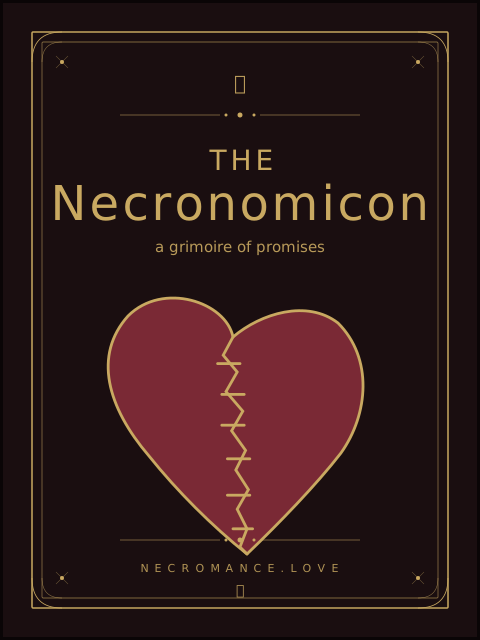
The Necronomicon
A grimoire of promises. The spells we will cast, the wards we will keep, and the bargains we will never strike.
I. The Resurrection
Necromance.love is, at this moment, an art project.
It is the concept of a dating website — one where you can make a profile, write to other people, and, if you are very lucky, get a reply. But it is mostly a joke being told out loud. The buttons say "Rise Again." The inbox is "The Séance Room." The form fields ask you for your time of death. None of this is by accident.
The art project is also a question. The question is: does anyone want a dating site that is not trying to ruin their day? If the answer is yes — if real people use this, and have a nice time, and find one another — then we will build a second version. A real one. Paid, sustainable, accountable. That version is described later in this document.
But the first version is the one that exists today, and it is allowed to just be the art. Not every project becomes a business, and that is fine.
II. Why a dating site themed around necromancy
A fair question. Three answers.
First, because online dating is in a kind of death. The optimism of the 2010s — the sense that the apps were going to be good, that they were going to help — has rotted. What we have now is a marketplace, and not a kind one. We want to bring back what is buried.
Second, because the imagery is honest about the work. We are not pretending love is easy or instant or always alive. Love dies. Sometimes it comes back. Sometimes it is stitched together from the pieces of what came before. The split-locket heart on our logo is broken and mending — that is the truest picture of romance we know how to draw.
Third, because if we are going to ask people to trust us with something as tender as their hope of finding someone, we would like to do so in a way that is also a little bit funny. The world is heavy enough. A dating site that takes itself completely seriously is, frankly, part of the problem.
III. The thing we are trying not to do
Before we say what we will be, we should say what we will not be.
The dating industry, as it stands, is one of the most quietly cynical corners of the modern internet. It is an industry that seems to be built on the principle that you, the lonely person, are most profitable when you are almost satisfied — close enough to keep paying, far enough to keep paying again next month. Every interface, every notification, every "see who liked you" paywall is tuned to that knife's edge.
We think this is bad. We think it has produced an internet full of people who are tired, suspicious, and lonelier than when they started. We think someone should try the opposite.
The specific patterns we refuse, today and forever:
- Swipe mechanics designed to feel like a slot machine
- Gating "who liked you" behind a paywall
- Artificially limiting your matches to push you toward an upgrade
- Notifications calibrated to maximize your time in the app
- Ordering profiles for "engagement" instead of for finding someone
- Algorithms designed to keep attractive users single longer so other users pay more to reach them
- Making the site harder to leave than it was to join
We will not measure our success by daily active users. We will measure our success by The Departure — people who found what they were looking for here.
IV. How we try to help
These are the spells, then. What the site does, and why it does it.
The Warding. A ward, in the old sense, is a small protection: a circle of salt, a word said over a threshold, a charm against unwelcome things. Ours is digital, but the idea is the same. This is a classy place, and we want to keep it that way. Before a message is sent, the Warding reads it. Most letters pass without notice; a few it holds, and asks the writer to try again. The Warding speaks for itself — we will not put words in its mouth on this page. We believe most people can be classy. We believe almost everyone wants to be. The Warding is one of the ways we have agreed to help each other be so.
The Introduction. Most real-world couples were introduced by a friend. We are building this directly into the site: you may recommend matches between people you know. When you recommend two people to each other, both of them see that the recommendation came from you. No anonymous matchmaking, no behind-the-scenes nudging. If you're going to vouch for someone, you put your name on it — exactly like real life. The technology in dating apps has spent fifteen years trying to replace this with algorithms, and the algorithms have not been better than your friends. We would rather make it easy for your friends to help.
The Plain Order. There is no engagement algorithm. Profiles appear in a simple order — most recently active, with some shuffling — and that is the whole secret. There is no model trying to maximize how long you stay. We will also tell you how recently someone has been here. A profile that has not stirred in months should not look the same as one that was here this morning — other sites blur that line on purpose, because a hopeful message sent into an empty room is still engagement, and engagement is what they sell. We would rather you knew. If a soul has gone quiet, we will say so, so you can spend your sincerity where someone is listening. This knowing is offered gently, and anyone who would rather not be seen coming and going may say so — we will keep that quiet too. If you find someone and close the tab, that is exactly what we wanted to happen.
The Spectrum. When you walk into a room at a party, you've already made a hundred small choices before you say a word to anyone. Who looks interesting. Who looks like your type. Who's already in a conversation you don't want to interrupt. Who reminds you of your ex in a way that's a no. This is normal. This is how attraction works. Pretending it doesn't is its own kind of lie. So we give you filters. A lot of them. Height, body type, age, distance, religion, politics, ethnicity, education, what kind of relationship you're looking for, when you want kids, whether you drink, whether you smoke, how active you are, what you do for work. Almost every dimension of a profile is something you can filter on, and you can stack the filters however you want. The site doesn't decide for you what matters. Some of these filters are controversial. Some sites have removed them. We've kept them because we trust you to know what you're looking for. A person who wants to date within their religious community should be able to find their community. A person who wants a partner with a similar education level should be able to find them. A person whose mom would like them to marry someone Korean should be able to look for someone Korean. A few filters come with a one-time note when you turn them on. Not a warning, not a guilt trip — just a heads up about what the filter does and what research has found about it, so you can make an informed choice. After that, we get out of your way. What we will not do is filter for you. There is no algorithm deciding who you see based on what we think you want. The filters are yours. The defaults are open. The choices are yours.
The Long Sleep. Dating is not linear. If you meet someone promising and want to step away, you can put your account into the Long Sleep: profile hidden, no charges (when there are charges), no notifications, no nagging emails. Wake it up any time. Stepping away is a normal part of dating, not a failure of it — we built the Long Sleep so it doesn't have to feel like quitting.
The Quiet Goodbye. When you want to delete your account, you delete your account. We will ask you to confirm — buttons are easy to hit by accident, and your data deserves a moment of pause before it disappears — but the confirmation is a question, not a guilt trip. No dark patterns, no fake reasons to stay, no "are you sure you want to leave all your matches behind?" If you tell us you found someone, we will celebrate with you. If you tell us nothing, we will wish you well. The same goes for canceling a paid subscription. Leaving this site should feel as graceful as joining it.
This section will grow as we build. Anything we add will be in service of one rule: features should help people find what they're looking for, not keep them looking.
V. The second version: when we go paid
Should the site rise. Should it be welcomed. Should it be needed enough to keep running. Then this is what we owe you.
These are pledges, not aspirations. If we are going to ask for money, we are going to do it in writing and in public before anyone has handed us a dollar.
The Ledger. We publish our finances. Not vaguely — a real page, with real numbers. Revenue, expenses, salaries when there are people to pay, server bills. With at least 95% of expenses accounted for. The rest is the slack we give a tiny team running a real business in real life. You know where your money goes.
The Descent. Most internet businesses climb. Ours descends. As we grow, the price goes down, not up. The goal of this site is not to get rich — it is to connect people. If the site is collecting more money than it needs to run, we lower the fee. Our aim is to get the monthly cost down to roughly the price of a cup of coffee, wherever you live. There is a floor below which the math stops working — enough to cover payment processing and meaningful profit-sharing with anyone who helps build this. Above that floor, every dollar we don't need belongs to the people paying for the site.
No premium tier. No "Necromance Gold." No "Plus." No coffin-shaped icon next to verified profiles. Every paying member sees the same site, with the same features.
No annual billing. Month-to-month, cancel anytime, no discount for committing longer. The moment you don't want to be here anymore, you should be able to leave without feeling like you've paid for ten more months of disappointment.
Pricing scaled by country. A dollar means different things in different places. We will not charge San Francisco rates in countries where that is a week's wages. The Descent applies in every market, scaled to local conditions — a cup of coffee where you live, not where we live.
No data sale. No ads. No brand partners. The three temptations that ruin internet businesses. We refuse all three.
Interaction with other users is what we charge for. Browsing, profiles, The Warding, and The Introduction stay free. We charge for reaching out — sending messages and the like — because it funds the site without locking up the parts that let you decide whether the site is for you. We will keep the price low enough that it functions as a courtesy filter, not a barrier.
The Vigil. A vigil is keeping watch over something precious, in the dark, until it is safe. We will keep this one. This is not a startup, and it is not for sale. We do not plan to take outside investment. We do not plan to be acquired. The transparency commitments above are incompatible with how most investors operate, and the mission of this site is incompatible with the kinds of growth most investors require. If we ever consider changing this — for any reason at all — we will say so here, publicly, before any conversation happens.
No stock, but a real share in what we build. If this becomes something more than one person, the people who help build it will share in what they build. There is no exit, so there will be no stock options — paper claims on a sale that isn't coming. Instead, we intend to share success through profit-sharing or, if we grow large enough to warrant it, a worker-owned cooperative structure. The specifics will be worked out when there are actually people to compensate, and they will appear on The Ledger when they exist.
The Ledger goes up on day one. Not "soon." Not "once we have time." Day one. If the page is not ready, the paid version is not ready.
VI. Listening, and the world
A spell only works if it can be revised.
The best way to build a site that genuinely promotes connection is to listen to the people using it. We intend to do this seriously. There will be a place to suggest features, raise concerns, and tell us what isn't working. The mechanics of that — how exactly it works, how we sort through what people say — we'll figure out as we go.
We are also thinking about this site as something that could, eventually, exist outside the place where it is being built. What helps people meet in one country or culture is not always what helps in another. We don't pretend to have figured out how dating should work everywhere — nobody has — but we look forward to learning, and to making space for people to find love in whatever way fits where they are.
A standing commitment: we will listen, but we will not be voted out of existence. This site has a vision, written down in this document, and the vision does not change because the loudest voices in the room would prefer something else. If your feedback fits the mission, we will likely build it. If it doesn't, we will tell you why, in public, and you will be free to disagree.
There is also a small, longer-shot idea we are sitting with: at some point, if this project earns it, we may open the source code. The financials will be public, the conduct will be public, the values are public — at some point the code being public completes the picture. We are not committing to this yet. It depends on whether the art project becomes a real thing, and on whether we can do it responsibly. But it is on our minds.
VII. Who is behind this
Trevor Ellermann — Necromancer
The "we" throughout this document is, for now, just me.
I'm a site reliability engineer and Eagle Scout. More than one person has told me I'm on their zombie apocalypse survival team. I can fix your car or your boat, build a house, run a festival for 80,000 people, build the infrastructure for a billion-dollar company, or run an internet connection in a war zone. Also: seventy-odd countries.
The story of necromance.love begins in 2023, when I was talking with some friends who were building a dating app — much love to the Bloom crew — and trying to do something more honest than the industry default. They got me thinking. Around the same time, I was, and still am, part of an art collective whose first principle is not to be talked about by name — a community of clowns making mischief together, with glee. Those two influences ran together in my head: what if the next dating site was a parody dating site? What would that even look like?
It was October. Halloween was on the brain. I was living on a sailboat. I registered the domain.
Since then I've had — ahem — a lot of opportunity to use dating apps myself, and to think hard about what I would do differently. What's written above is what I came up with. I can't wait to see how it turns out.
If this becomes something more than one person can carry, the people who join will be named on this page, with their titles. Their compensation will appear on The Ledger. Nothing about who runs this site will be a secret.
VIII. A note on the dead
The imagery is gothic, but the mission is not morbid. We use the language of mourning because mourning is the most honest language anyone has ever found for love that didn't work out. Anyone who has been through a breakup, or a divorce, or the slow death of a marriage that looked fine from the outside, knows that grief and dating live next door to each other.
We are not making light of any of this. We are making space for it.
If you have been hurt by online dating — if you have spent money on apps that lied to you about how they worked, if you have been ground down by mechanics designed to keep you almost-but-not-quite finding someone — we are sorry. We are trying to make a thing that does not do that.
IX. How to reach us
Until the parlor opens for visitors: leave your email in the box on the front page, and we will write to you when we are ready.
After: every email we send is signed by a person, with a real reply address. We are not hiding behind noreply@. We never will.
This book is unfinished, and will remain so. New pages will be written; some pages will be revised; nothing will be quietly erased. When this book changes, the changes will be noted.
Nothing here is a promise we cannot keep. Everything here is a promise we intend to.
Set down by Trevor. Last revised on: 2026-05-29T01:22:21-07:00